
Syndicated post from InmanNews.
Source link
The Trump administration’s bid to oust Federal Reserve governor Lisa Cook could give it a foot in the door to exert even more control over the central bank’s rate-setting committee. But usurping the Fed’s independence might backfire and push mortgage rates higher if bond markets revolt, skeptics say.
At stake is control of the central bank’s rate-setting Federal Open Market Committee (FOMC), which consists of 12 voting members: The seven members of the Board of Governors of the Federal Reserve System, plus five presidents of regional Federal Reserve banks.
If the Trump administration succeeds in ousting Cook over allegations of mortgage fraud — she’s fighting the move in court — it will have appointed four of the seven members of the Fed’s Board of Governors.
“We’ll have a majority, very shortly so that’ll be great once we have a majority, and housing is going to swing and it’s going to be great,” President Trump told reporters this week.
Next on the Trump administration’s agenda: Flex the Board of Governors’ power to approve — or reject — appointments of regional bank presidents in February, Bloomberg News reported this week, citing anonymous sources.
That’s a possibility that alarms former Fed officials and economists, who say undermining confidence in the Federal Reserve’s independence could make investors less eager to fund U.S. debt. If investors get cold feet about buying government bonds and mortgage-backed securities, that could push long-term interest rates higher — even if the Fed cuts short-term rates.
“By moving preemptively to remove a governor from the Federal Reserve without going through the process, without there being any clear evidence, the president essentially is moving to shift the majority of the Board of Governors well before what was contemplated,” former Fed Vice Chair Lael Brainard told Bloomberg.
“That opens the door when renewals of all of the Reserve Bank presidents come up in February to … take very unprecedented actions and potentially not renew some of them in order to shift the overall voting majority on the FOMC,” Brainard, an Obama appointee, said. “That is an unprecedented attack on the independence of the Federal Reserve, and it should really concern us about their ability to continue to be credible in fighting inflation and keeping our economy on a strong course.”
For months, the Trump administration has been pressuring Fed Chair Jerome Powell to lower rates or resign — a campaign that’s included allegations that Powell mismanaged renovations of the central bank’s Washington, D.C., campus.
Powell has said the Fed must base its interest rate decisions on economic data and not be swayed by politics. But Powell’s term is up in May, and Treasury Secretary Scott Bessent is interviewing candidates to succeed him, Bloomberg reported.
Candidates who aren’t picked as Fed chair “may be considered for regional Fed bank president roles instead, according to the person familiar with the administration’s efforts,” Bloomberg reported. The White House and the Fed did not respond to the publication’s request for comment.
“Removing bank presidents would be an unprecedented violation of norms,” Greg Ip, The Wall Street Journal‘s chief economics commentator, wrote this week. “But Trump has demonstrated repeatedly he is willing to violate norms.”
While Federal Housing Finance Agency Director Bill Pulte and other Trump administration officials say they want to see lower mortgage rates, economists point out that the Fed can’t dictate long-term interest rates.
The central bank has monetary policy levers it can pull that give it direct control over the short-term federal funds rate. But investor demand for bonds and mortgage-backed securities determines interest rates paid by homebuyers and the government when it borrows money.
Mortgage rates have a mind of their own
When the Fed cut the short-term federal funds rate by a percentage point at the end of last year, mortgage rates went up by an equal amount when inflation moved away from the central bank’s 2 percent target.
“I would suspect that not only the U.S. bond markets, but global bond markets would riot pretty decisively” if investors believed the Trump administration was influencing Fed policy, BMO Private Wealth chief market strategist Carol Schleif told Reuters.
But Schleif also noted that President Trump and Treasury Secretary Bessent “have been very cognizant of understanding how the bond market reacts, and so they’ll watch that and hopefully tone it down — much as they did back in March and April, when the conversations about potentially firing Powell sent markets into concern.”
Some observers think investor perception of Fed independence has already been damaged because whoever succeeds Powell will be seen as willing to bend to Trump’s will.
Allianz Chief Economic Advisor Mohamed El-Erian, who urged Powell to resign in July, said Thursday that “attacks on the institution have since broadened and deepened, and now, worrisome cracks are beginning to appear in a long-standing principle that is crucial to the well-being of both the American and global economies.”
The idea that the Trump administration might interfere in February with the reappointment of the presidents of the 12 regional Federal Reserve banks “is deeply unsettling” to someone who believes in the importance of an independent Fed, El-Erian said in a Yahoo Finance op-ed.
So far, bond market investors haven’t panicked. Yields on 10-year Treasury notes and mortgage rates have come down significantly since Aug. 22, following Powell’s final address at the Jackson Hole symposium.
By acknowledging that the central bank is starting to see unemployment as a bigger risk to the U.S. economy than inflation, Powell convinced investors that the Fed will start cutting rates again in September.
But Ip warned that investors “have no historical template for a politicized Fed and assume its leaders under Trump will behave as they have under previous presidents, setting interest rates according to the economic data and their forecast.”
Investors “would be wiser to assume that starting sometime in the next nine months, the Fed will set rates according to Trump’s preferences,” Ip wrote for the Journal.
All of the Fed policymakers rated as “hawkish” on inflation by Reuters (and therefore less receptive to cutting rates) are regional Federal Reserve bank presidents.
The 12 regional Federal Reserve banks
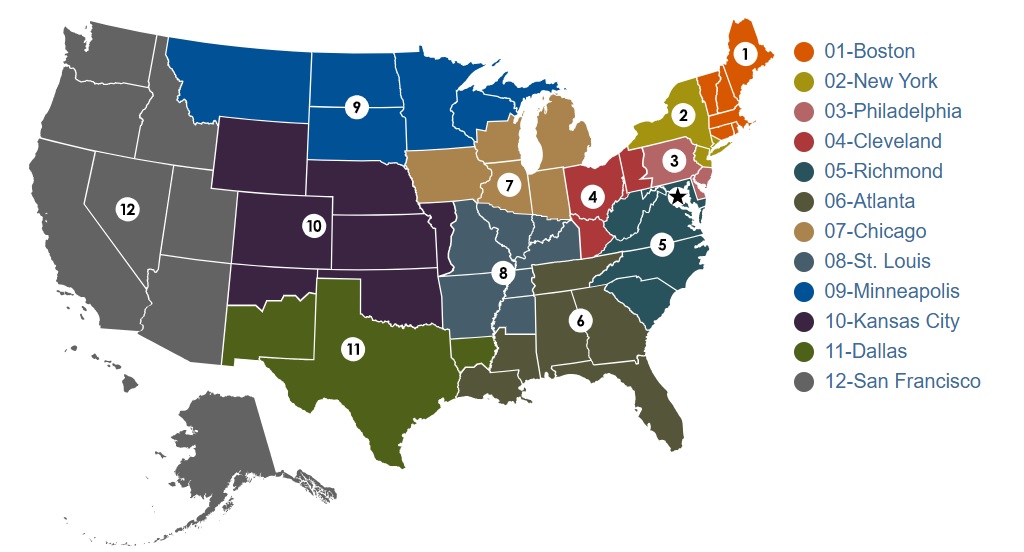
Source: Federal Reserve Board.
There are a dozen regional Federal Reserve banks. Only the president of the Federal Reserve Bank of New York has a permanent seat on the rate-setting Federal Open Market Committee (FOMC). The other 11 regional bank presidents take turns holding the four other seats on the rate-setting committee reserved for them, with each serving one-year terms.
The seven members of the Board of Governors of the Federal Reserve System, including Powell, are permanent members of the FOMC.
Federal Reserve Board Governors Michelle Bowman and Christopher Waller are Trump appointees who cast the lone votes in favor of lowering interest rates in July.
The Aug. 8 resignation of Governor Adriana Kugler, a Biden appointee, gave Trump the opportunity to nominate Stephen Miran, chair of the White House Council of Economic Advisers, to serve out the rest of Kugler’s term.
This week Trump said he might want to have Miran fill Cook’s seat instead of Kugler’s, since Kugler’s term expires in January, 2026, while Cook’s term runs until 2038.
“Look, we just put a very good man in one position, [maybe] we switch him to the longer term and pick somebody else,” Trump said of Miran. “But we’re very happy with the person we have in there.”
In a statement, Democratic Sen. Elizabeth Warren said she “will have tough questions for Miran” at his confirmation hearing, calling him “a Trump loyalist and one of the chief architects of President Trump’s chaotic tariff policy that has hurt Americans’ wallets and our economy.”
But Miran is expected to be confirmed in time to attend the Fed’s Sept. 17 meeting, where futures markets tracked by the CME FedWatch tool on Thursday predicted there’s an 87 percent chance of a 1/4 percentage point rate cut, up from 63 percent on July 28.
It’s unclear if Cook — who, ironically, is classified by Reuters as “dovish” on inflation and would be likely to favor a rate cut — will be allowed to attend the Fed’s September meeting as she challenges Trump’s attempt to remove her.
“If Trump’s effort to remove Lisa Cook for cause succeeds, and perhaps even if it doesn’t, this week will go down as one of the most consequential for financial markets in decades,” Ip wrote for the Journal.
Get Inman’s Mortgage Brief Newsletter delivered right to your inbox. A weekly roundup of all the biggest news in the world of mortgages and closings delivered every Wednesday. Click here to subscribe.

